
Schema Therapy
The Defectiveness Schema: When Being Known Feels Unsafe
October 5, 2026 · Reading Time: 10 min
The defectiveness schema can make being known feel unsafe. Explore signs, shame versus guilt, and practical steps toward connection and self-respect.
What is the defectiveness schema?
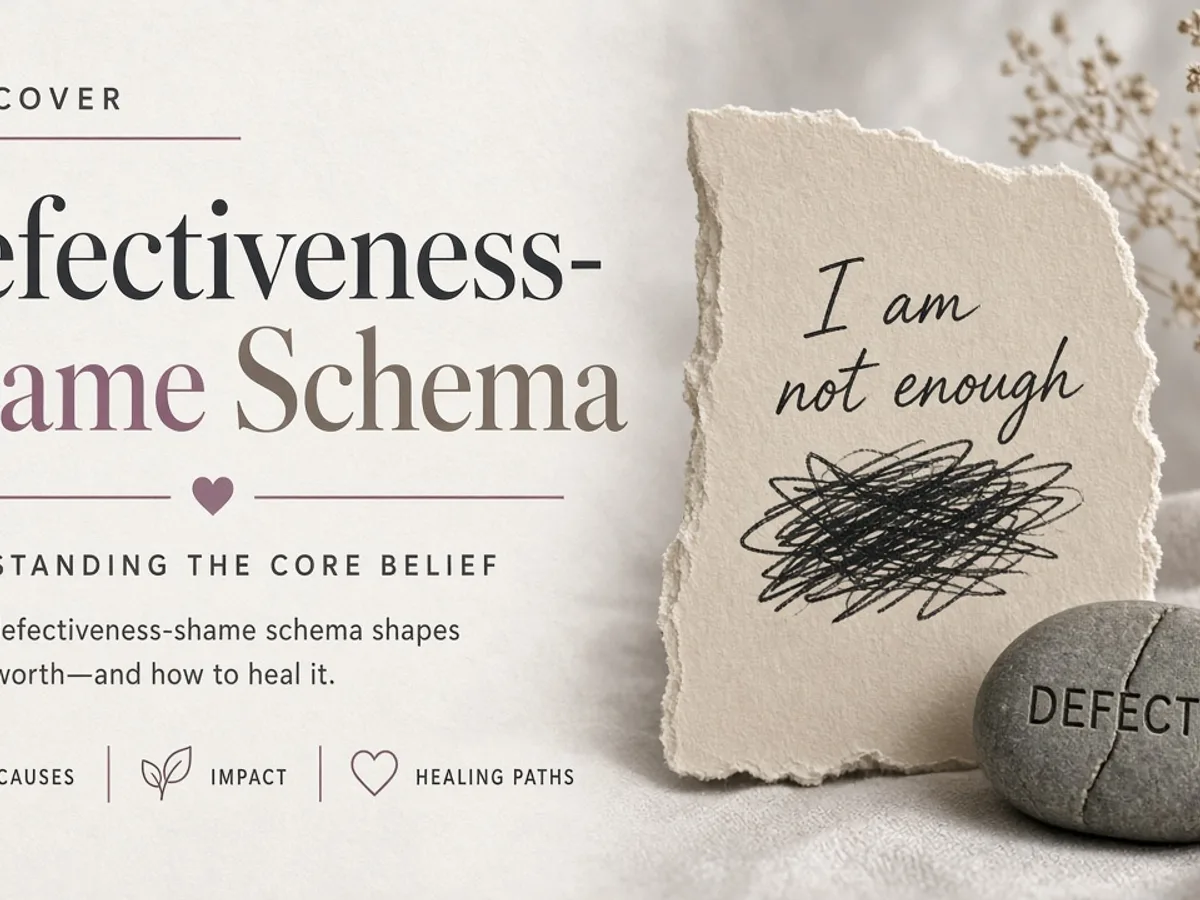
The defectiveness schema, also called defectiveness/shame, describes a persistent pattern of experiencing yourself as fundamentally flawed, inferior, or unlovable. Its central fear may be that important people would reject you if they knew you more fully. The term names an emotional pattern within schema therapy; it does not establish that something is wrong with your worth.
Someone can seem capable and confident while privately struggling with this feeling. A compliment arrives, but the mind responds, “They would not say that if they really knew me.” A relationship becomes closer, but closeness brings apprehension: “Sooner or later, they will discover the part I need to hide.”
This is different from occasionally feeling embarrassed or regretting a mistake. To understand a possible schema, look at how often the pattern appears, how intense it becomes, and how it affects your choices. A familiar example in an article is a starting point for reflection, not a diagnosis. For the broader framework, see what schema therapy is designed to change.
Possible signs in ordinary life
The following examples illustrate experiences to explore. They are not a validated checklist, and similar difficulties can occur with social anxiety, depression, or other concerns.
Feedback becomes a verdict about your whole self
A colleague asks you to clarify one section of a report. Instead of evaluating that request, you find yourself thinking, “I am incompetent. I should never have accepted this role.” The feedback concerns a piece of work; the internal conclusion concerns your entire identity.
You may spend hours recovering from something the other person considered routine. It can help to notice where the shift happened: when did “this needs revision” become “I should not be here”?
Affection feels difficult to trust
You may want closeness and struggle to receive it at the same time. You explain kindness away as pity, politeness, or a reward for what you provide. If a friend enjoys your company, your mind may insist that they only like the useful, entertaining, or carefully edited version of you.
These explanations are interpretations. They deserve examination rather than automatic acceptance simply because they feel familiar.
Ordinary needs seem too revealing
Feeling tired, needing support, not knowing something, or having an uncomfortable emotion may seem like evidence that you should be rejected. You work hard to appear calm, organized, and undemanding.
The practical cost can be loneliness. Other people may know a great deal about your schedule and achievements while knowing very little about the part of you that needs company or care. They cannot reliably respond to information they have never received.
Comparison becomes a judgment on your right to belong
Another person is skilled at something, and your mind translates their ability into your inferiority. Rather than thinking, “They have expertise I could learn from,” you think, “Their competence proves I have less value.” A comparison between abilities has become a comparison between human worth.
The question worth exploring is not whether you can stop noticing other people. It is whether noticing them has to become a trial in which you always lose.
Shame versus guilt: where is the judgment directed?
A common distinction in psychological research is that guilt focuses more on an action, while shame focuses more broadly on the self. “I did something hurtful” and “I am a fundamentally bad person” create different starting points for a response. Real experiences are more complex than this shorthand, and the two emotions can overlap.
| Situation | A specific, accountable response | A global attack on the self |
|---|---|---|
| I spoke harshly | I need to apologize and change how I respond | I am an awful person |
| I did not know the answer | I can ask and learn | Asking will expose my worthlessness |
| I need support | I can make a clear request | Having needs makes me unacceptable |
Responsibility without self-humiliation
Respecting yourself does not cancel responsibility. If your behavior hurt someone, its impact matters. You may need to listen, apologize, repair what you can, and make a different choice next time.
Self-humiliation is not that repair. Spending an evening telling yourself you are terrible does not necessarily help the other person or change what happens tomorrow. A more useful question is, “What specifically needs to change, and what action would show that I understand?”
How might this pattern develop?
Schema therapy understands longstanding patterns in the context of temperament and developmental experiences. There is no single childhood event, family structure, or parent that explains everyone’s experience.
For your own reflection, consider what happened when you made mistakes, differed from others, or needed comfort. Was a specific action discussed, or was your whole character attacked? Could you ask for help without being ridiculed? What meaning did you give to exclusion or comparison? Were there also people with whom you felt accepted?
These questions help build hypotheses. They do not prove that a particular event caused a schema, and they do not require turning your history into a prosecution of your family.
Present conditions matter too. Discrimination, repeated humiliation, or a relationship that undermines your dignity should not automatically be reclassified as an internal sensitivity. An old fear and a genuinely harmful interaction can both be present. Understanding one should not erase the other.
How hiding can keep the fear untested
Imagine believing that asking for reassurance will make someone leave. You never ask. The relationship continues, but your mind explains, “They stayed because I concealed that need.” Nothing in this sequence tests whether a respectful request would actually be welcome.
Another example is accepting a degrading remark. Instead of evaluating the speaker’s behavior, you conclude that a better person would not have been treated that way. Their conduct becomes evidence against you, and the important question—whether the conduct is acceptable—disappears.
Someone else may respond to feedback by attacking immediately. That response could be an attempt to escape feeling exposed. It may also hurt the other person. Understanding the protective purpose of a reaction can support change while leaving responsibility for its effects intact.
These examples are possible formulations, not explanations to impose on every instance of silence, defensiveness, or distance. The useful task is to understand what a particular response does in your life: what it prevents, what it costs, and whether it still serves you.
A worked example: asking a question without putting yourself on trial
This example is fictional and does not come from a client’s records.
Maya is in a meeting and does not understand a technical term. She wants to ask, but thinks, “Everyone will realize I am out of my depth.” She stays silent, misses part of the discussion, and criticizes herself afterward.
A different response does not require instant confidence. Maya can first describe the situation more narrowly: “I do not know how this term is being used in this project.” She can then ask, “Could you clarify what you mean by that here?”
Afterward, she needs an accurate account of the outcome. A helpful answer does not prove that every person will always be kind. A dismissive reaction does not prove that Maya is inferior. Each response gives information about the interaction and the person responding.
Keeping the conclusion specific matters. The purpose of the experiment is to gather information and practice a choice, rather than arrange a final referendum on Maya’s worth.
How it differs from abandonment and the inner critic
The central theme of defectiveness is often “I am not lovable.” The abandonment schema concerns expecting important people to become unavailable or leave. The themes can overlap: “They will leave when they discover what I am really like.”
The inner critic is also not identical to the schema. A persistent theme of inferiority may be reinforced by a momentary critical voice: “You ruined it again.” Distinguishing the belief from the voice that attacks you can make the next response more precise. The inner critic and unrelenting standards explores that part of the picture.
There is no need to label every feeling. The distinction is useful when it changes what you do next: seek comfort, examine a prediction, correct a behavior, or set a boundary around disrespect.
Working with the defectiveness schema
Therapy starts with an individual assessment and a shared understanding of triggers, needs, and responses. Depending on the person, schema therapy may combine cognitive work, experiential methods such as imagery rescripting or chairwork, behavioral practice, and a supportive therapeutic relationship with professional boundaries. These are possible methods rather than a fixed treatment prescription.
Consider feedback about a particular behavior without repeatedly attacking your identity.
Express a manageable need in a trustworthy relationship.
Apologize and make repairs when your behavior has caused harm.
Evaluate disrespect instead of assuming you deserve it.
Let a compliment stand briefly without immediately arguing against it.
Compassion-based approaches may also be relevant to self-criticism. A randomized trial in people with elevated self-criticism reported encouraging results for an online compassion-focused intervention. It did not establish that a kind sentence alone changes the defectiveness schema, or test a dedicated treatment for that schema.
The Healthy Adult perspective does not have to sound relentlessly positive. A credible response might be: “That feedback hurt. We can consider the useful part without humiliating you.” Schema modes provides a fuller map of this capacity and other inner states.
Privacy remains part of healthy connection. You do not need to reveal every thought, experience, or vulnerability to prove that you are changing. Disclosure can be gradual and selective, with attention to whether the other person handles information respectfully.
A brief exercise: from a verdict to a next step
This is a reflection exercise, not a diagnostic instrument or a stand-alone treatment. Choose a recent, mildly difficult situation rather than your most painful memory.
1. Record the event
“My friend said they could not talk today.” Keep this separate from what you think it means.
2. Name the verdict
“I am too much. Nobody can tolerate me.”
3. Identify the feeling and need
“I feel ashamed and disappointed. I want company and a clearer idea of when we can connect.”
4. Write a more precise response
“Their availability today is one piece of information. If this happens repeatedly, I can discuss the pattern.”
5. Choose a small action
“I will ask about another time and return to something else for now.”
Afterward, ask what you learned. Did the action address your need? Did it clarify the situation? Did you punish yourself? The aim is observation rather than a perfect performance.
If the exercise becomes overwhelming, stop and return attention to your surroundings. Bring it to a therapist if appropriate. You do not need to flood yourself with distress to make progress.
Frequently asked questions
Does feeling defective mean I really am defective? No. The intensity of a feeling does not establish a verdict about your worth. Everyone has limitations and makes mistakes. The schema can turn these ordinary realities into a global sense of being unlovable.
Can a successful person have a defectiveness schema? Yes. Achievement and feeling accepted are different experiences. Someone may feel tolerated only because they perform well. However, success or perfectionism alone does not establish that this schema is present.
Do I need to tell my partner everything to change? No. You retain the right to privacy and to choose timing and audience. Healthy openness is selective and responsive to trust. It does not require sharing sensitive information with someone who uses it against you.
Can affirmations treat the defectiveness schema? There is insufficient basis for promising treatment through affirmations. A believable statement may help you pause. Persistent patterns can require behavioral practice, examination of relationships, and sometimes psychotherapy.
When is professional help appropriate? Seek an assessment when shame repeatedly interferes with work, intimacy, or expressing needs, particularly alongside depression, self-harm, or ongoing mistreatment. If there is an immediate risk of harming yourself, prioritize emergency support where you live.
References
International Society of Schema Therapy. Schema Therapy Central Concepts. https://www.schematherapysociety.com/Schema-Therapy
Young, J. E., Klosko, J. S., & Weishaar, M. E. (2003). Schema Therapy: A Practitioner’s Guide. Guilford Press. https://www.guilford.com/books/Schema-Therapy/Young-Klosko-Weishaar/9781593853723
Tangney, J. P., Stuewig, J., & Mashek, D. J. (2007). Moral emotions and moral behavior. Annual Review of Psychology, 58, 345–372. https://doi.org/10.1146/annurev.psych.56.091103.070145
An Internet-Based Compassion-Focused Intervention for Increased Self-Criticism: A Randomized Controlled Trial (2019). PubMed record, PMID: 30824257. https://pubmed.ncbi.nlm.nih.gov/30824257/
Awareness does not erase an old pattern overnight. It gives you a place from which to choose your next response.
A Closing Reflection
Progress with the defectiveness schema can mean noticing something you want to change while continuing to treat yourself with dignity. Today’s step might be asking a question, accepting a compliment without instantly dismissing it, or challenging a degrading remark. A useful question is: “If my worth were not on trial today, what responsible action would I take?”
Reviews & comments
No comments yet. Be the first to share your experience.