
Schema Therapy
Schema Modes: A Clear Map of Inner States
August 31, 2026 · Reading Time: 9 min
Schema modes are temporary emotional, cognitive, and behavioral states—not separate personalities. A map of four mode families, how they differ from schemas, and how to name what is active now without turning it into an identity.
A Mode Is Not Your Personality; It Is the State That Is Active Now
Schema modes are temporary emotional, cognitive, and behavioral states that come forward in different situations. You can feel calm and reasonable one moment, and a few minutes later—after a sentence, a look, or a small event—suddenly feel small, angry, distant, or as if you must defend yourself at once.
In Schema Therapy these shifts are not evidence that you have several personalities. They show which part of the psychological system has taken the front of the room in that particular moment. This article offers a simple map of schema modes. It is not a label for who you are.
Imagine you start the morning well: you think clearly and feel in control. Then someone in a group says something that lands badly. You shrink, flush with shame, get angry, or want to leave the room entirely. A few minutes later you may think: why was that so intense? I was fine before.
Schema Therapy describes that sudden change as a schema mode. A mode is a temporary organization of feeling, thought, body, and action. In that moment the system is arranged in a particular way. One part may be afraid, another angry, another scolding, another pulling away so that nothing more has to be felt.
Naming a mode is not meant to explain everything about you or the other person. It is a tool for seeing the experience more precisely. Saying my Vulnerable Child is active now does not prove that your reading of the situation is correct, or that you know the other person’s intention. It simply gives you a better question: which part of me is reacting? Or, in a simple image: who is holding the microphone right now?
What Is the Difference Between a Schema and a Mode?
When people first learn schema therapy, the difference between a schema and a mode is often the first confusion. A schema is more like a deep, relatively stable pattern. Over a lifetime, schemas shape what you expect about yourself, other people, and relationships: Will they stay or leave? Am I worthy of care? Can I trust anyone? Do my needs matter?
A schema can sit quietly for a while and barely be noticed. Then a particular event lights it up. Someone with an abandonment schema, for example, may feel sudden, intense insecurity when a partner is slow to reply to a message. The schema is the background pattern. The mode is the state that appears in the moment when that pattern is activated.
The same abandonment schema can produce different modes in different situations. One time you feel like a small child who is afraid of being left. Another time an inner scolding voice says you should not need so much. Another time you go cold and decide it no longer matters. Another time you get angry, control, or attack so that you do not have to feel weak. The schema may be one. The mode that steps forward can still change.
If you want more on how these patterns form and repeat, why the same emotional patterns keep repeating looks at how a trigger, a meaning, and a coping move can restart an old cycle.
For a First Map, Four Families of Modes Are Enough
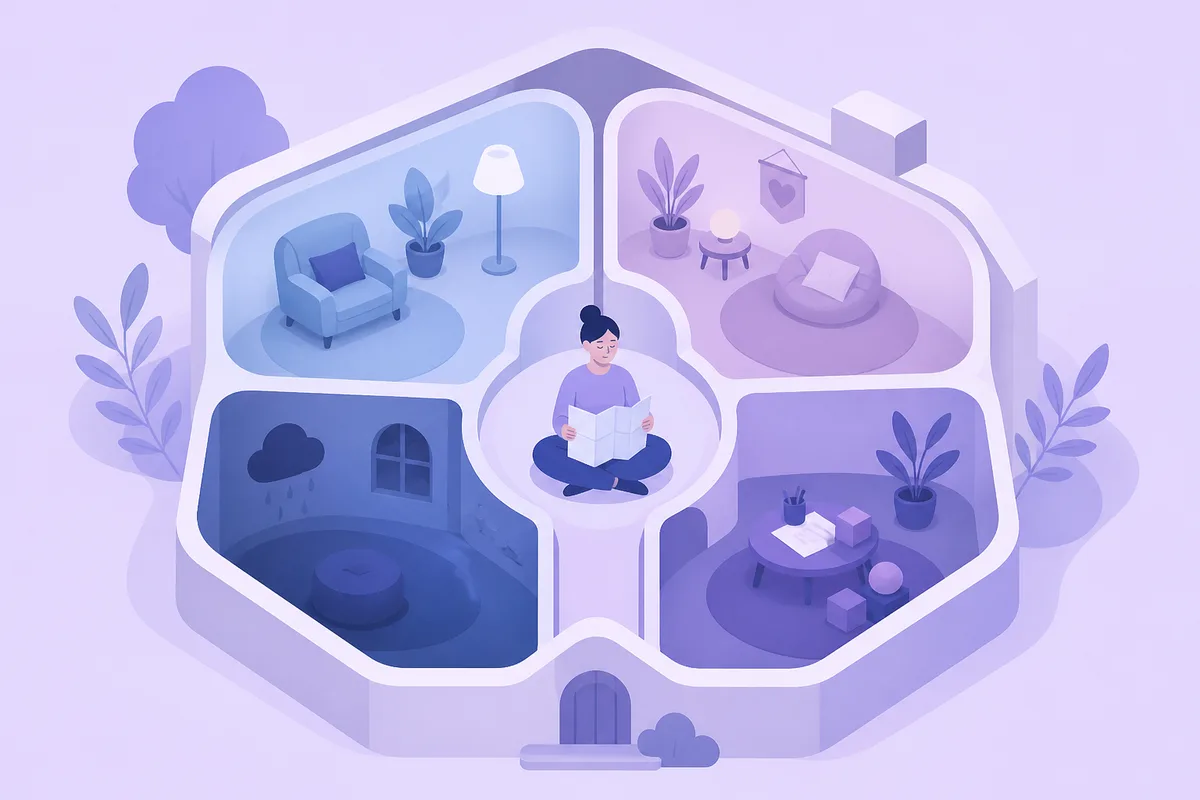
Contemporary Schema Therapy describes many specific modes. You do not need to memorize the full list to begin. For a working overview, it is enough to think in four families: child modes, dysfunctional parent modes, coping modes, and the Healthy Adult. Picture rooms in one house. You are not any single room. In the course of a day you may walk through several of them.
Child modes bring us closest to deep, early feelings and needs. The Vulnerable Child may feel lonely, afraid, worthless, ashamed, or unsafe. The Angry Child may protest when needs feel ignored. The impulsive or undisciplined child may struggle to bear frustration or to delay a wish. The Happy Child appears when there is enough safety, freedom, connection, and acceptance to be playful, curious, and alive.
Dysfunctional parent modes are usually internalized voices that speak as a harsh or punitive parent might: you must not make a mistake; you have to be perfect; why are you so weak; you have no right to be upset. They may take a punitive, criticizing, or demanding form. The difficulty is that when they are active they often feel like truth, not like an inner voice.
When the Vulnerable Child’s experience becomes too painful, coping modes usually step in. These are the ways the system has learned to manage pain, fear, shame, or insecurity. Some people surrender to the schema: they keep others pleased or set their own wishes aside. Some distance: they numb feeling, pull back from the relationship, occupy themselves with work, the internet, sleep, or other activity, or pretend that nothing matters. Some overcompensate: they try, through control, superiority, attack, competition, or a display of strength, to show the exact opposite of what they feel inside.
These moves are not always healthy or useful. They are rarely random either. Often they once helped you feel less pain. The four families are not there to pin you to one room forever. They are there so that when your inner state changes, you can see a little more clearly what has arrived: a deep feeling and need, an inner verdict and pressure, a way of coping with schema pain, or the Healthy Adult’s care and choice.
Modes Can Change Very Quickly
A shift between modes is not always conscious or deliberate. A late message, a look, a small mistake, a comparison, a criticism, or a change of tone can be enough to activate an old pattern. The emotional and bodily reaction may start so fast that you find yourself in a familiar state before you have had a chance to think about the situation.
The Vulnerable Child may come forward and you feel you are about to be left. Then the inner parent arrives: here you go again; how weak you are. A few minutes later a coping mode appears: I do not care anymore. The sequence can be so fast that you only see the outcome: a message you wish you had not sent, a silence that lasted days, an apology you did not really want to make, or an extreme effort to be perfect so that you would not have to feel inadequate.
One aim of Schema Therapy is for this chain to become gradually visible—not so that you can scold yourself, but so that a little space opens between activation and the next move.
Coping Modes Are Not the Enemy
When people first recognize their coping modes, they often start a war with them: I should not pull away this much; why do I always please people; why do I become controlling when I am afraid? That stance rarely helps.
Coping modes usually formed when the system had no better way to live with pain. Emotional distance may once have been a way to feel less. Keeping others satisfied may have been a way to avoid rejection. Control or overcompensation may have been a way to escape weakness or shame.
Seeing that function is not the same as approving every behavior. It simply makes it possible to stop fighting yourself blindly and to ask what the reaction was trying to protect. Sometimes the more useful question is not how do I get rid of this immediately, but: if this protector stepped aside, what feeling would be underneath?
What Does the Healthy Adult Do?
The Healthy Adult is not required to be calm, positive, or fully reasonable at all times. It can be upset, angry, afraid, or in need of distance. The difference is that it can see a little more. It can notice: my Vulnerable Child is frightened; the inner critic has started sentencing; I am pulling away from feeling. Then, instead of becoming identical with that mode, it can choose the next step with a little more awareness.
The Healthy Adult usually does several things at once: it sees the feeling, takes the need seriously, checks today’s reality, and chooses a behavior that is as kind to the self as it is fitted to the situation. Care without reality-testing collapses into the child’s panic. Reality-testing without care is criticism dressed as logic.
If a partner is slow to reply and your Vulnerable Child has activated, the Healthy Adult does not say nothing happened, you are being too sensitive. It might say: I understand that this delay has frightened you. The fear is real. A late reply does not yet mean the relationship is in danger. You do not need to send three more messages right now. We can wait a little, and then, if needed, speak about the need directly and clearly. The feeling is seen, reality is checked, and a next step is chosen.
If the inner critic is the loudest voice for you, the inner critic and unrelenting standards looks at that part of the map in more depth.
Name the Mode That Is Active Now, Not Your Personality
You do not need a complicated analysis to begin. Choose one situation from the last few days after which you thought my reaction was too strong, I did not feel like myself, or I do not know why I suddenly became so cold, small, angry, or anxious.
Then ask four short questions. First: what happened? Which sentence, behavior, thought, or bodily feeling started the reaction? Second: which mode arrived first—a child mode, an inner parent, or a coping mode? Third: if a coping mode arrived, what feeling was it trying to protect you from—fear, shame, loneliness, worthlessness? Fourth: what could the Healthy Adult have said or done? Not a pep talk. Not a harsh order. A sentence that takes the feeling seriously and still sees today’s reality.
For example: I understand that you are afraid, but we do not yet know what this means. Or: you have a right to be upset, but you do not have to end the relationship right now. Or: this mistake hurts, but making a mistake does not mean I am worthless.
The Name of a Mode Is Not Your Name
One risk of learning psychological language is turning it into identity too quickly: I am a Vulnerable Child; I am a Detached Protector; I am an avoidant person. Modes are not meant to be a complete definition of you. It is more accurate to say my Vulnerable Child sometimes becomes active, or in some situations I use a distancing mode. That small change in language makes a large change in how you see yourself.
A mode is a state, not your whole personality. Once you can recognize its name, it is a little easier to make space between what has activated inside and what you want to do next. The map will not stop every shift. It can help you, when you enter one of these rooms again, to know where you are—and perhaps to have a little more choice about the next step.
Further Reading
International Society of Schema Therapy. Schema Therapy: Core Concepts. https://schematherapysociety.org/schema-therapy
Young, J. E., Klosko, J. S., & Weishaar, M. E. (2003). Schema therapy: A practitioner’s guide. Guilford Press.
Edwards, D. J. A. (2022). Using schema modes for case conceptualization in schema therapy. Frontiers in Psychology, 12, 763670. https://doi.org/10.3389/fpsyg.2021.763670
This state is active in me now; it is not all of me. That small gap is sometimes the first step toward a different response.
A Closing Reflection
Schema modes are temporary states that can shape feeling, thought, body, and behavior in a particular moment. A schema is the deeper, relatively stable pattern; a mode is the state that appears when that pattern lights up. For a first map, four families are enough: child modes, dysfunctional parent modes, coping modes, and the Healthy Adult. Naming a mode should not become a new label for who you are. The aim is to be able to say: this state is active in me now, but it is not all of me.
Reviews & comments
No comments yet. Be the first to share your experience.